
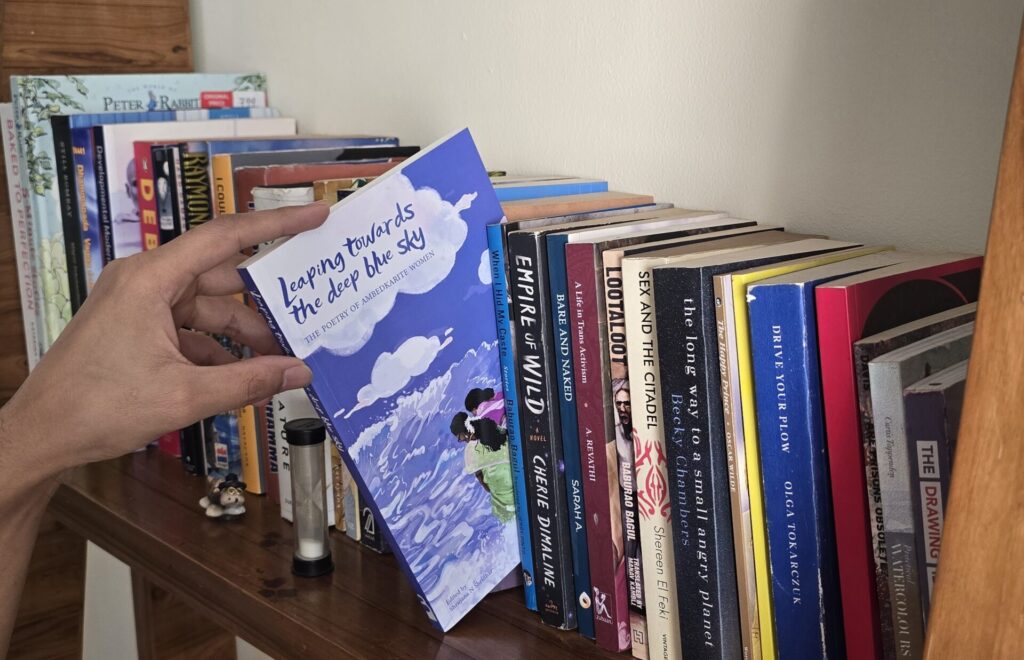
Introducing ‘Leaping towards the deep blue sky: The Poetry of Ambedkarite Women’
We see the world around us closely when Dalit women write. As a first-generation graduate in my family, I fell in love with reading and writing in all its forms early on. As I devoured school history and language text books, the only literature I had access to as a kid, my desire to read more and express myself in written word only grew with time. Studying journalism was a conscious choice, one that exposed me to different political thoughts and Bahujan artists and writers. Like many of us, Dr Ambedkar’s writings shaped my understanding of caste oppression and how it violently harms marginalised communities. It felt like finding the most important piece of a puzzle, and I knew what triggered a churn in my belly when as a child I heard stories of caste untouchability against my family back in our village, or the rage I felt against the sufferings of our people, most intimately the women around me.
This is one of the reasons why in my initial readings of Dalit women’s poetry, I found deepest resonance in the words of Dalit poet Jyoti Lanjewar. Her poem “Mother” struck a chord with me: “Mother, I have never seen you, wearing one of those gold-bordered sarees, with a gold necklace….I have seen you, washing clothes and cleaning pots, in different households, rejecting the scraps of food offered to you with pride.” These lines speak to the experiences of the women around me, my grandmother, mother, aunts, and sisters-in-law. These are women who did not have the opportunity to gain formal education, but are curious, bold, self-reliant leaders in the truest sense of the word. It’s enraging to realise that they will never fully enjoy the freedom they desire, or articulate their struggles and pain in the same manner as some of us have the opportunity to do. Leaping Towards the Deep Blue Sky captures the lives and spirit of several such Dalit women, through bold yet poignant verses, contributing significantly to the discourse on liberation and gender justice. Here, I attempt to give a glimpse of the historical contribution of Dalit women authors from Maharashtra to Indian literature, while introducing the newly published anthology by Maveli Publications. I had the opportunity to have in-depth conversations with poets Chhaya Koregaonkar, Pradnya Pawar, and Shital Sathe, who entrusted me with their stories. Their experiences, in addition to further readings and personal reflections, majorly shape this introductory essay.
In a profoundly unequal society, not everyone enjoys the privilege of writing for pleasure, or even has access to different kinds of literature. From India’s pioneering feminist leader Savitribai Phule to contemporary Ambedkarite women writers, Dalit women who could read and write have always used writing as a powerful tool. Dalit feminist literature in the post-independence period was pioneered by writers who firmly believed that their writings must provoke discomfort and introspection in readers, urging them to challenge societal norms, particularly regarding gender and caste. But in doing so, they also inspire a raging call for love, warmth, and the resilience to fight oppressive forces.
These writers were mainly informed and inspired by the lives of the leaders of the social reform movement, mainly Savitribai Phule, Mahatma Jyotiba Phule, and Dr Babasaheb Ambedkar. While women from the marginalised communities have authored radically powerful texts since a long time in history, the pervasive influence of upper-caste women within India’s mainstream feminist discourse ensured that Dalit feminist writings were confined to limited audiences. Their reluctance to engage with caste underscored the need for broader engagement and inclusion of Dalit women writers within feminist spaces; we delve deeper into this later in this essay.
Meeting Babasaheb in Dalit women’s writings
Although Dalit women’s writings gained prominence in the late 1970s and early 1980s, their literary contributions date back to the anti-caste movement spearheaded by Dr Babasaheb Ambedkar. His advocacy for active participation of women in socio-political reform is well documented. His speeches, notably the one delivered at the Chavdaar Tank Satyagraha in Maharashtra’s Mahad, inspired Dalit women to embrace individuality, self-esteem, and instilled a vigour for participating in the movement. As Urmila Pawar and Meenakshi Moon illustrate in ‘We also made history: Women in the Ambedkarite Movement’, women’s voices and writings found regular expression in newspapers like Bahishkrut Bharat, Janata, Prabuddha Bharat and other periodicals launched by Babasaheb. Their writings spanned from scathing critiques of oppressive upper-caste Hindu customs and untouchability, to discussions on Buddha’s teachings, Babasaheb’s works, and anecdotes of encounters with their revered leader.
In addition to gratitude and admiration, women’s writings about Babasaheb carries familial warmth and a sense of kinship, with a leader they saw as a father, mother, and even a son. In the words of writer Pradnya Pawar, for Dalit women, Babasaheb epitomised a figure who recognised them first as human beings, entitled to equal rights alongside men. It is this affirmation of personhood, and encouragement for participation in the knowledge process that also resonates in the poetry in this book. By dismantling ideas rooted in brahmanical patriarchy that reduced Dalit women to objects of sexual exploitation, these writers fiercely rejected existing social structures to assert their identity. Hira Bansode perfectly captures this awakening in her poem Lekhani Bhimachi (translated as ‘Bhima’s Pen’), when she writes:
I am not just a homemaker
Nor am I a thing of beauty bathed in moonlight
Born from the embers of infinite pain,
Inked by Bhimrao’s mighty hands
I am his fiery words
Like flowers burning in wildfires
My mothers and sisters are charred
How can I forget the story of women’s oppression?
Ravaging the chests of those tyrants
I am a roaring sangini
Kindled by Ambedkar’s spirit
Moving to verse: Poetry in Marathi Dalit literature
Spearheaded by leaders like Namdeo Dhasal, Baburao Bagul, Daya Pawar, J.V Pawar and Raja Dhale, the Dalit literature movement set a storm in Maharashtra’s literary ecosystem and disrupted traditional brahmanical norms in mainstream Marathi literature. Its distinctiveness in form, tone, expression, and imagery was borne out of the lived experiences of those who suffered, actively participated in early social reform movements, faced incarceration, raised families, protested on the streets, but wielded pen and paper as a tool of resistance. It was during this period that Dalit women writers also embarked on a journey of self-exploration and engagement with the movement, through prose and poetry. Against the backdrop of the raging Dalit Panthers movement in the 1970s, was born the ‘Mahila Sansad’, a collective formed in Mumbai in the 1980s. The collective, led by luminaries of Marathi Dalit literature such as Hira Bansode, Urmila Pawar, Kumud Pawre, and Jyoti Lanjewar, later gave rise to the the ‘Samvadini Dalit Stree Sahitya Manch’. This platform provided a space for Dalit women’s narratives and recognised their contribution to the ongoing Dalit literary movement in Maharashtra.
Early autobiographical accounts by Dalit women, including, Jina Amucha by Babytai Kamble, Antahsphot by Kumud Pawade, Majya Jalmachi Chittarkatha by Shantabai Kamble, Aaydan by Urmila Pawar, and others laid the foundation of Dalit feminist literature. Subsequently, writers like Bansode, Lanjewar, Surekha Bhagat, and contemporary poets like Pradnya Daya Pawar, Chhaya Koregaonkar, Sheetal Sathe, and Disha Pinki Shaikh amongst others turned to poetry as a means of assertion and protest. As Chhaya Koregaonkar put it succinctly during our conversation, poetry is a concentrated form of one’s expression; allowing one to convey what’s in their heart in lesser words. For Koregaonkar, it was her passion for music that fostered her interest in poetry at an early age. Although she is also known for her novels, it’s poetry that inspires her emotionally. She believes, “It [poetry] either directly enters one’s mind or their kaleja [liver],”– a popular expression, which would essentially mean “piercing the heart”.
Initially, Dalit women’s poetry predominantly conveyed their anguish against oppressive structures and entrenched casteist notions. It revealed their own encounters with caste discrimination and spotlighted how caste and gender intersect, leaving them doubly marginalized and sidelined from the Ambedkarite movement. In the poem Dohale (Translated as ‘Cravings’), Hira Bansode’s moving imagery of the occasion of a woman’s baby shower and references to Mahad Satyagraha is suggestive of the way Dalit women assimilated the movement’s purpose in their daily lives, as well as on celebratory events.
Questions coiled around her,
And suddenly, she had this unbearable thirst for
The charged waters of Mahad.
She rose,
Shaken by the injustice of the Poona Pact
A sudden bolt of lightning struck her mind
She was overjoyed, overwhelmed,
The sunrays that emerged from within her
Her cravings soaked in their brightness
Cravings, cravings so bold and fierce!
The early 21st Century marked the rise of contemporary Dalit women’s poetry, introducing a new generation of poets unafraid to delve into the complexities of personal identity in context of political processes. Pradnya Pawar, in particular, highlights the multifaceted manifestations of caste in urban settings and in cosmopolitan cities like Mumbai. In her experience, combating the upper-caste gaze and casteist stereotypes was part of her daily struggle to assert her presence in Mumbai’s academic spaces. Despite being an established poet and professor of Marathi literature, she was often questioned about her Dalit identity. Her upper-caste colleagues remarked that she did not “look like a Dalit” and could speak “pure Marathi”, which, to them, seemed surprising and atypical for a Dalit person.
“The purity and impurity of language defined Dalitness according to their understanding. What should a Dalit woman look like? What should she wear, eat, and speak like? What should her body language look like? All of these nuances are looked at and commented over by people in cities. These casteist innovations are all being written about in contemporary poems by Dalit women,” she shares.
Breathing life into the movement, which she believes has waned since the Dalit Panthers, is imperative. Poems by Pawar and several contemporary Ambedkarite women including Varsha Bhise, Rajyashi Goody and more, published in this book, communicate the urgency to resist institutional injustice against marginalised communities and the rapid erosion of democratic institutions. This resistance must utilise all available means, whether poetry, painting, music, street protests, drama, or any other forms, to combat tyranny.
In discussing resistance through music and poetry, the significant contribution of renowned Shahir Shital Sathe is unmissable. Her unpublished poems, featured in this anthology, reflect her experiences of facing incarceration with her partner Sachin Mali, her relationship with her mother, and her commitment to challenging unjust customs. Affected by the State’s apathy towards rights of the marginalised she asserts, while the State may imprison the body, it cannot contain one’s mind, ideas, and expression within the confines of prison walls.
In writing about revolution, Dalit women show us how survival itself becomes a form of protest for women from the community. The cycle begins from their mothers whose love, labour and relentless pursuit of education for their children serve as the foremost source of inspiration for many. These writings also reveal the evolution of Dalit women’s poetry over time, transitioning into a more intimate exploration of their lives, delving into deeper nuances. One can witness a glimpse of the seemingly simple yet complex relationship between a Dalit mother and a daughter who’s taken the path of revolution in Sathe’s poem Maher (Translated as Mother’s Home).
Although the poem delves into the sorrow of leaving her maternal home upon marriage, it also serves as a reflection of Sathe’s own challenges, periodically separating from her home and mother to perform songs of protest nationwide. The poem also highlights the physical and emotional labor expected of women, often leaving them with a profound sense of fatigue and emptiness. She writes:
Does the umbilical cord ever truly dry out?
But time inflicted a wound on the soul,
The essence that once bonded, has evaporated
Kinship chiseled into dense blocks
What was once a generous welcome, now dried up
Accepting insults as gifts from close ones…
My lap is filled with pain
When mother’s home becomes alien…
But the daughter dies…but the daughter dies.
Resisting censorship within the community
When writing about oppression, Dalit women openly addressed the violence they faced from Dalit men, emphasising the need for intersectional discourse in pursuing systemic change. However, this has unsettled many men in the community. Despite claiming to follow Babasaheb’s teachings, Pradnya Pawar and Koregaonkar say that several Ambedkarite men have succumbed to patriarchal values.
Within the community, male leaders often judge a woman’s writings based on her lifestyle and personal choices. They also dictate norms around the issues that Dalit women should address. The poets reveal that women’s writings about gender discrimination, domestic violence, sexual harassment, and the exploration of sexuality—topics that do not directly reference revolution or caste reform outside their household—often go unrecognised within the community. Instead, these writings are dismissed as being influenced by Western feminist thought, which emphasises individuality. Consequently, women who write about these issues are often marginalised, their work unacknowledged, and they are not invited to share their views publicly. “My writings weren’t even criticized; they were simply ignored. Neglect is more painful than criticism,” Koregaonkar shares.
While the slogan ‘personal is political’ continues to drive many social justice movements, Dalit women have faced criticism for applying this principle in their poetry. Writings about violence inflicted by husbands, for example, was seen as a minor issue considered to be counter-productive to the revolutionary legacy of the Ambedkarite movement. Contrarily, Pradnya Pawar affirms that while women’s writings are often criticised for being confined to domestic realms and lacking global relevance, Dalit women’s writings were never perceived in the same light. These writings laid bare the entrenched caste, gender and patriarchal dimensions of inequalities which affected Dalit women the most.
The tendency of male writers to sanitise or criticise women’s expressions all contribute to potential self-censorship. It not only impacts Dalit women’s full participation in the movement, but also dilutes the powerful messages they aim to convey through their words.
‘Upper-caste feminists do not see us as equals’
Facing the twofold blow of caste and brahmanical Patriarchy, women from our community realised early on that their emancipation was pivotal to setting the movement for equality in motion. Writing their stories and perspectives in their own words was fundamental to registering their voice during tumultuous times. The impulse to articulate through the written word was also fueled by a purpose: to defy the casteist norm that Dalits should be denied education. While home became the implementing body of regressive beliefs and customs, writing emerged as a defiant act against a life of slavery imposed by the Hindu dharma and religious texts. This is true even today for many Dalit women. Amidst these obstacles, a pressing question remains: Until when will upper caste writers, who enjoy the privilege to access a wider audience, claim authorship over Dalit women’s lives and realities?
Upper-caste women have continued to generalise the experiences of Dalit women, failing to acknowledge the intersection of caste and feminism in India, whether through their literature or on public platforms. Pradnya Pawar and Koregaonkar make it clear that not all women are equal, and importantly, feminism is not homogenous. Dalit women poets recognise that while upper-caste women writers have also been victims of brahmanical patriarchy, these same women have often disregarded Dalit feminist writers. Due to their socio-economic capital, upper-caste women enjoy some amount of power, but have shown a strong reluctance to let Dalit women lead important conversations.
The insecurity of upper-caste feminists in literary circles is evident in several instances, such as confining Dalit women’s writings to “Ambedkarite criteria” or denying them a platform at major literature festivals. Koregaonkar shares that at public forums and literature award functions, she was mainly seen as a competitor by upper-caste women writers, who showed little interest in engaging with her meaningfully as a contemporary. She recounts being treated “like an untouchable” during such gatherings.
“Their approach towards Dalit women’s literature is sympathetic. They don’t see us as equals. They don’t want us to sit, walk or work with them together for equality, or achieve greater milestones than them. They still have that saviour attitude, the sympathetic or pity-oriented approach towards us. The fact that they have made up their mind to see us as inferior to them leaves me with a pricking feeling inside,” Koregaonkar says.
The appropriation of Dalit women’s writings through translations is another attempt by upper-caste feminists to widen their reach and gain social capital. Although these translations inform more people about Dalit women’s writings, they primarily bring recognition to the upper-caste women who translate them. Koregaonkar firmly believes that their intention is often driven by personal interests rather than an honest effort to convey Dalit writings to a broader audience. Despite these difficulties, Pradnya Pawar and Koregaonkar believe that all women writers, regardless of caste or other differences, deserve recognition for their work.
The pursuit of self-respect and liberation from constraints that stifle a Dalit woman’s way of life should not be more challenging for the younger generation. I firmly believe that this poetry book, published by Maveli Publications, plays an important role in emboldening the cause: to expand the horizons of Dalit literature, and connect with the readers who are seeking hope, guidance against caste, and the courage to dream.
This anthology is meticulously curated by Shrujana N Shridhar–one of the most celebrated and cherished artists of our time–and translated by Shrujana and Shreeja Rao, whose prowess shows in her incisive journalistic writings. Leaping Towards the Deep Blue Sky: The Poetry of Ambedkarite Women serves as an important work, offering readers an opportunity to acquaint themselves with the reflections of Dalit women, whose distinct contribution to literature remains sparsely recognised.